ERC-8499: Hash-Based Key Derivation from BIP-39
Derives hash-based post-quantum keys from a BIP-39 phrase using hash functions only.
Abstract
This ERC specifies how a wallet derives the secret seeds of hash-based post-quantum keys from a BIP-39 recovery phrase. Every secret is derived with HMAC-SHA512: in BIP-39's own PBKDF2, and then in HKDF. It never passes through BIP-32 or any elliptic-curve operation, so a quantum adversary who breaks every ECDSA key made from the same phrase learns nothing about the hash-based keys.
The core is a root secret from the phrase and a seed for each stateless key, named by an account and a key type. The ERC defines the key types of SLH-DSA, the stateless hash-based signature of FIPS 205, so two wallets that implement the core derive the same SLH-DSA key pairs from the same phrase. Three optional derivations cover what one wallet never restores from another: seeds for stateful keys, secrets for applications, and roots for devices that hold no phrase.
Motivation
Hash-based signatures are the most conservative post-quantum option for Ethereum accounts. Accounts can already verify them in contracts through ERC-1271 and account abstraction, and EIP-8288 would aggregate them in the protocol. Users, however, back up their accounts with BIP-39 phrases, and no standard says how a phrase becomes a hash-based key.
Implementations have diverged:
- One derives keys from the phrase's BIP-39 entropy, with Keccak-256 over application-specific labels.
- Another runs BIP-39's PBKDF2 over the phrase a second time, with its own salt in place of
"mnemonic". - A third runs HMAC-SHA512 over the BIP-39 seed, under its own label.
The same phrase therefore gives different keys in different wallets, and a phrase restored elsewhere does not restore the keys.
A standard derivation lets a user:
- restore hash-based keys in any conforming wallet, hardware wallet or recovery tool;
- add hash-based keys to an existing phrase without a new backup;
- move to a new parameter set, for example the one a future protocol upgrade fixes, by deriving a new key from the same phrase.
A wallet that already has BIP-32 might derive these keys through it. Every BIP-32 node has an elliptic-curve public key, however, and hash-based keys should not depend on any value that such a key can reveal. The Rationale gives the argument.
This ERC covers the keys of accounts. The keys that validators sign consensus messages with are outside its scope: ERC-8517 derives their seeds, and the Rationale says why the rules differ.
Specification
The key words "MUST", "MUST NOT", "REQUIRED", "SHALL", "SHALL NOT", "SHOULD", "SHOULD NOT", "RECOMMENDED", "NOT RECOMMENDED", "MAY", and "OPTIONAL" in this document are to be interpreted as described in RFC 2119 and RFC 8174.
Conformance
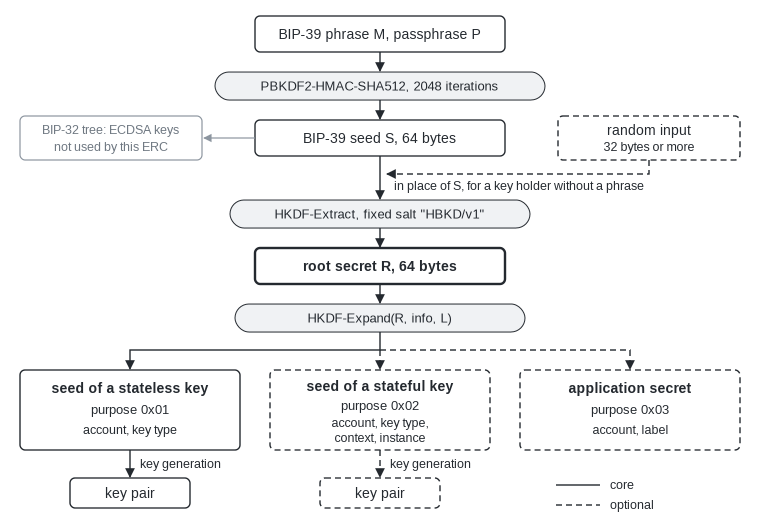
This ERC has a core and three optional derivations.
- A wallet conforms to this ERC if it implements the core: the root secret of a BIP-39 phrase, accounts, key types, the seeds of stateless keys, the key types of SLH-DSA, and the rules for restoring. Two conforming wallets derive the same stateless key pairs from the same phrase.
- A wallet MAY implement any of the optional derivations: stateful keys, application secrets and random roots. A wallet that implements one MUST follow its section.
A wallet MUST NOT derive any value of this ERC through BIP-32 or any other step that involves elliptic-curve arithmetic.
The figure shows the derivations, the core in solid lines and the optional ones dashed.
Notation
||is byte concatenation.be16(x)andbe32(x)are the 2-byte and 4-byte big-endian encodings of a non-negative integer below2^16and2^32.len8(b)is the length of the byte stringbas one byte.bis at most 255 bytes long.ascii(s)andutf8(s)are the ASCII and UTF-8 encodings of a strings, without terminator or length prefix.HKDF-Extract(salt, IKM)andHKDF-Expand(PRK, info, L)are the two steps of HKDF as RFC 5869 defines them, with SHA-512 as the hash.HKDF-Extractreturns 64 bytes, andHKDF-ExpandreturnsLbytes.
Core derivation
Root secret
A root secret R is 64 bytes. With mnemonic sentence M and BIP-39 passphrase P (the empty string if the user sets none):
S = BIP39-Seed(M, P)                                 64 bytes: PBKDF2-HMAC-SHA512, 2048 iterations, as BIP-39 specifies
R = HKDF-Extract(salt = ascii("HBKD/v1"), IKM = S)
M is the phrase's words exactly as they appear in the BIP-39 wordlist it was made with, separated by single spaces. Wallets MAY support only the English wordlist. A wallet MUST bring what the user types (other letter case, other spacing, abbreviated words) into this form. It MUST reject a mnemonic with a word outside the wordlist or a failed BIP-39 checksum. BIP-39 only asks for a warning, but a mistyped word that passes would restore different keys.
Derived values
Every seed and secret of this ERC is an output of HKDF-Expand(R, info, L):
info = purpose || be32(account) || be16(L) || len8(name) || name || tail
| Field | Bytes | Value |
|---|---|---|
purpose | 1 | 0x01 for a stateless key; in the optional derivations, 0x02 for a stateful key and 0x03 for an application secret |
account | 4 | the account, below |
L | 2 | the number of bytes derived, 32 <= L <= 16320 |
len8(name) | 1 | the length of name, from 1 to 255 |
name | 1 to 255 | the key type, or the application's label |
tail | 0 or 64 | empty, or context || instance for a stateful key |
Accounts
account is an integer 0 <= account < 2^32. Different values give independent sets of keys from one root, like the account level of BIP-44. Wallets SHOULD use accounts in order from 0, without gaps.
Key types
A key type is a string of 1 to 255 printable ASCII characters other than the space, that is of bytes 0x21 to 0x7e. It identifies:
- the signature scheme;
- its parameter set and hash function;
- whether its keys are stateless or stateful;
- its signature limit, the number of signatures up to which one key keeps the security level of the key type;
- the length
Lof its seed, at least 32 bytes; - the deterministic procedure that makes a key pair from that seed, including every option that changes the public key, such as pruning the key's top tree.
This ERC defines the key types of SLH-DSA, below. A key type string without / is defined by this ERC. Every other key type string MUST start with the name of its definer and /: eip- or erc- with the number of the proposal that defines it, or a domain name that the definer controls. A key type string MUST change whenever the map from seed to public key changes. Two different procedures MUST NOT share a key type string. A scheme with a parameter that differs from key to key, such as the height of a tree, therefore has one key type string for each value. A scheme whose key generation takes several secret values, or more than 32 bytes, sets L to what it needs and says how the seed is cut up.
Stateless keys
The seed of the stateless key of type t for account is:
seed = HKDF-Expand(R, 0x01 || be32(account) || be16(L) || len8(ascii(t)) || ascii(t), L)
The key pair is the key type's key generation applied to seed. Restoring R MUST restore the same key pair.
A key type whose secret key changes with use, such as a one-time key, a few-time key or a key with an index, MUST NOT be derived as a stateless key. A restore would bring back keys that have already signed.
SLH-DSA key types
The key types of SLH-DSA are the names of its parameter sets as FIPS 2051 writes them. They are stateless key types with a signature limit of 2^64: a wallet MUST NOT derive a stateful seed under these names. With n the parameter set's hash length in bytes:
| Key types | n | L |
|---|---|---|
SLH-DSA-SHA2-128s, SLH-DSA-SHA2-128f, SLH-DSA-SHAKE-128s, SLH-DSA-SHAKE-128f | 16 | 48 |
SLH-DSA-SHA2-192s, SLH-DSA-SHA2-192f, SLH-DSA-SHAKE-192s, SLH-DSA-SHAKE-192f | 24 | 72 |
SLH-DSA-SHA2-256s, SLH-DSA-SHA2-256f, SLH-DSA-SHAKE-256s, SLH-DSA-SHAKE-256f | 32 | 96 |
The seed has L = 3n bytes and is cut into the three inputs of FIPS 205's key generation, in this order:
SK.seed = seed[0 : n]
SK.prf  = seed[n : 2n]
PK.seed = seed[2n : 3n]
(SK, PK) = slh_keygen_internal(SK.seed, SK.prf, PK.seed)          FIPS 205, Algorithm 18
The public key is PK.seed || PK.root, of 2n bytes. A wallet MUST NOT derive an SLH-DSA key pair of these key types in any other way from R.
Restoring
These rules are part of the core.
Fingerprint
After restoring R from a phrase, a wallet SHOULD show the root's fingerprint, or an address derived from a stateless public key, before the user relies on the keys. A mistyped BIP-39 passphrase gives a valid but different root, and comparing the fingerprint with a known one is how the user notices.
The fingerprint of a root is the first 4 bytes of the SHA-256 hash of its SLH-DSA-SHA2-128s public key for account 0, written as 8 hexadecimal digits. A wallet MUST NOT compute a fingerprint from R, from the BIP-39 seed or from a key's seed directly.
Finding accounts
A phrase does not record which accounts and key types were in use. A restoring wallet SHOULD try the accounts in order from 0, with each key type it supports, and stop at the first account for which it finds no key in use. How a wallet finds that a key is in use, for example through an account contract that names the public key, is outside this ERC. A wallet or application that uses accounts out of order MUST record which ones it uses, since a restore will not find them.
A key that its account has replaced, for example after a move to a new parameter set, still counts as in use. A wallet SHOULD therefore keep trying, on restore, the key types it has stopped using for new keys. Which of its keys an account accepts now is for the account to say.
A restore that finds no key in use does not show that the phrase holds none. The phrase may hold keys of a type the wallet does not support, keys that another wallet derived in a way other than this ERC's, or accounts that were used out of order. A mistyped passphrase gives the same result. A wallet that finds no key in use SHOULD tell the user so, and SHOULD say first what the user can do: try the wallet that created the phrase, which may find keys that this one did not. It SHOULD also name the key types it tried. They mean little to most users and a lot to whoever helps them, so a wallet can show them as details.
Signature counts
A phrase does not record how many signatures a key has made, and a wallet MUST NOT assume that a restored key has not signed. A wallet SHOULD therefore sign with a phrase-derived key only in a use that cannot reach the key type's signature limit, counting every wallet that holds the phrase, signing as fast as that use allows, for the key's lifetime. Where signing transactions could reach the limit, the phrase's key SHOULD only certify other keys. Each device then signs with a key of its own, for example a stateful instance or a key under a random root as defined below, and a restore costs the phrase's key one signature, on the new device's certificate. What a certificate says and how an account checks it are outside this ERC.
A wallet whose use could reach the limit depends on a count. A restore brings none, unless a backup of the count comes with it and covers every wallet that holds the key. Without one, the wallet SHOULD sign with that key only what replaces it, and continue with the key of the next account or of another key type.
Optional derivations
Stateful keys
A stateful key is one whose secret key changes with use: a one-time or few-time key, or a many-time key with an index, such as WOTS, FORS or XMSS. It MUST NOT be reproducible from the root alone. Each instance has:
context: 32 bytes the application defines, for example a hash of the chain, the account and the purpose. Applications SHOULD use it to bind each instance to its use;instance: 32 bytes from a cryptographically secure random number generator, generated when the instance is created.
seed = HKDF-Expand(R, 0x02 || be32(account) || be16(L) || len8(ascii(t)) || ascii(t) || context || instance, L)
The key pair is the key type's key generation applied to seed. A stateful key type MAY also give context to its key generation as a public input, for example to compute the public seed of a tree. How it does so is part of the procedure that the key type string names.
The public seed, or whatever else keeps the hash calls of one key pair apart from another's, MUST differ between instances. Where several instances can have the same context, the key type computes that value from context and instance, or cuts it from seed.
A wallet that holds a stateful instance:
- MUST NOT derive
instancedeterministically, and MUST seed its generator from a source that does not repeat across restarts before it creates an instance; - MUST store
instancewith the instance's state, such as which indices have signed, and MUST save that state before it releases a signature; - MUST create new instances after it is restored from its root, and MUST NOT recreate an instance from a backup of
instanceunless that backup also restores the instance's state, and the state is the latest.
A device that cannot store state reliably MUST NOT hold a stateful instance. A signer whose memory or storage can be copied while it runs MUST NOT hold one either. Both use stateless keys, or ask a single signer that holds the instance.
Application secrets
An application that needs its own secret derives it as:
secret = HKDF-Expand(R, 0x03 || be32(account) || be16(L) || len8(utf8(label)) || utf8(label), L)
where label is a string the application chooses, of 1 to 255 bytes in UTF-8 without Unicode normalization, and L is the length the application needs, 32 unless it says otherwise. Labels SHOULD be ASCII, and SHOULD be namespaced with a domain or project name the application controls. An application secret MUST NOT be used as the seed of a key type; stateless and stateful keys have their own derivations above. It MAY be used as other key material, for example as the private key of an ECDSA account that pays an application's gas. A quantum adversary who breaks such a key learns that secret only, not R.
Random roots
A key holder without a phrase, such as a device or an automated signer that a phrase-derived key certifies, makes its root from random input:
R = HKDF-Extract(salt = ascii("HBKD/v1"), IKM) IKM: at least 32 bytes from a cryptographically secure random number generator
Every derivation of this ERC applies to such a root unchanged.
Rationale
Hash functions only. BIP-32 mixes elliptic-curve arithmetic into derivation. A quantum adversary who holds an extended public key at any hardened level can compute that node's private key and chain code, and then every hardened child below it: hardened derivation protects against classical leaks, not quantum ones. Extended public keys at the account level are routinely exported to watch-only software. Keys derived from the BIP-39 seed by hashing alone are protected by HMAC-SHA512 alone: breaking every elliptic-curve key in the phrase's BIP-32 tree yields at most the BIP-32 master key and chain code, and neither reveals the BIP-39 seed.
The BIP-39 seed, not the entropy. Deriving from the seed keeps BIP-39 passphrases meaningful: each passphrase, including a hidden-wallet passphrase, gets its own hash-based keys. It also works for hardware wallets and libraries that keep only the seed. Deriving from the entropy avoids a second secret whose typos give valid keys, and at least one implementation chose it for that reason. This ERC keeps passphrases because users with existing phrases rely on them, and asks wallets to show a fingerprint after a restore instead.
Other derivations. A second PBKDF2 over the phrase with its own salt also gives a secret independent of the BIP-32 tree, but a wallet that keeps only the BIP-39 seed cannot compute it. It adds no protection against a quantum adversary either, since the BIP-32 tree already sits behind HMAC-SHA512, which hides the seed. ERC-2333 also derives with hashes only: each child key is computed from its parent's secret key through an intermediate Lamport key, which is meant as a post-quantum backup. But it derives BLS12-381 keys and ties its tree to that curve. BIP-85 takes its secrets from the private keys of BIP-32 nodes, so it depends on that tree. The hardened derivation that SLIP-0010 defines for Ed25519 uses HMAC-SHA512 alone, and a tree of such steps under a master string of its own involves no elliptic curve either. ERC-8517 builds such a tree for validator seeds. This ERC uses a single HKDF step instead of a tree. A key is named by a key type string, and the key type sets the length of its seed. A path of numeric indices would need a registry of numbers for key types and a further step for the length.
A small core. A standard has to fix only what two implementations must agree on. For key derivation that is the path from a phrase to a key pair: the root, the account, the key type and the stateless seed. A hardware wallet can implement that much and restore the keys of any other wallet. Stateful instances are never restored, application secrets matter to one application, and a random root never leaves its holder, so no two wallets need to agree on them. They are optional, and specified here so that wallets which need them do not each invent a variant. One rule about them is part of the core, because breaking it is unsafe: a stateful key type never takes the stateless derivation.
Finding accounts after a restore. BIP-44 wallets find their accounts by scanning in order and stopping at a gap. The same works here if wallets use accounts in order. What "in use" means depends on the account contract, which this ERC does not define, so the ERC fixes only the order, and that a key its account has replaced still counts. Without that, the scan would stop at the first account whose key was replaced. Where an account's address follows from its first key, that key is also how a restoring wallet finds the account.
The fingerprint. BIP-32 takes a key's fingerprint from its public key, and this ERC does the same. Users keep the fingerprint with the phrase, where whoever finds both can test guesses of the passphrase against it. A fingerprint computed from the root would let them test at the speed of the PBKDF2. Computed from an SLH-DSA-SHA2-128s public key, each guess also costs a key generation of about 290,000 hash computations, against 4,096 for the PBKDF2. One fixed key type, defined in this ERC, lets every wallet show the same eight digits for a phrase.
HKDF-SHA512. HKDF is the standard way to turn one secret into many, and reviewers and libraries know it. With SHA-512 it runs on HMAC-SHA512, which every BIP-39 wallet and hardware wallet already has for PBKDF2 and BIP-32, so the derivation adds no primitive to a BIP-39 wallet. It adds little time either: on a 240 MHz microcontroller with SHA-512 in software (an ESP32), the root takes about half a second, nearly all of it in the PBKDF2 that BIP-39 already requires, and each 32-byte value derived from the root about a millisecond. The derivation's hash is independent of the signature scheme's hash, so a scheme that settles on another hash still uses this derivation.
Extract under a fixed salt. HKDF-Extract is HMAC-SHA512(key = salt, message = IKM). BIP-32 makes its master key the same way under the key "Bitcoin seed", and SLIP-0010 separates curves by changing that string. The salt "HBKD/v1" separates this ERC's root from all of them. The version sits in the salt and nowhere else, so a later version changes every derived value at once. Random input takes the same step, so a device key without a phrase is made the same way as a phrase key.
The layout of info. RFC 5869 leaves info to the application. Four choices shape it:
- Every field has a fixed width or a length byte. Two different sets of inputs therefore never encode to the same bytes. Without the length byte, the key type
abfollowed by a context starting withccould equal the key typeabc. - The purpose comes first, as one byte. A stateless seed, a stateful seed and an application secret can then never coincide, whatever follows.
- The key type and the label go in as they are. HKDF takes
infoof any length, so hashing them first would only add a step and a second place for implementations to differ. Lis part ofinfo.HKDF-Expandproduces its output block by block, so withoutLininfoa 32-byte seed would be the first 32 bytes of a 48-byte seed for the same inputs. TLS 1.3 puts the length into its HKDF labels for the same reason.
Integers are big-endian, as in BIP-32.
Seed lengths per key type. Schemes need different amounts of secret input. SLH-DSA takes three values of 16 to 32 bytes each. With one fixed seed length, every such scheme would have to invent its own expansion. Here the key type asks for the bytes it needs. The floor of 32 bytes keeps a careless key type from deriving a short seed.
SLH-DSA key types. Without one fully specified key type, two conforming wallets would agree on a seed and still make different keys. SLH-DSA is the hash-based signature with a published standard and independent libraries, so it is the one this ERC specifies itself. The seed is cut in the order in which FIPS 205 lays out the private key, SK.seed || SK.prf || PK.seed, which is also the order in which at least one widely used library takes a seed for deterministic key generation. PK.seed becomes public. Taking it from the same output is safe, since revealing part of an HKDF output says nothing about the rest. The same rule can name parameter sets that NIST adds later.
The key type in every seed. A seed is never shared between two parameter sets or key-generation procedures, so a weakness in one cannot carry over to the other through a shared seed. When a protocol upgrade fixes a new parameter set, the wallet derives a new key from the same phrase under the new key type. An application can then link the new key to the old one by signing it with the old key, without a new backup.
Names of key types. Proposal numbers and domain names are already unique, so key type strings need no registry. The secure shell protocol names its algorithms in a similar way (RFC 4251).
Random instances for stateful keys. Stateful keys fail when an index signs twice. A deterministic stream of keys indexed by a counter repeats keys whenever a wallet is restored from an old backup, copied, or run on two devices. A per-device identifier only moves the problem: the same device restored twice repeats its stream. A phrase backs up an identity, not state, so this ERC restores stateless keys and makes fresh stateful instances. context binds an instance to its use, and an application can certify a new instance with its stateless key. Because the seed also depends on R, a stored instance and its state are not secret: whoever copies them still cannot sign without the root.
Validator keys. The keys that validators sign consensus messages with are outside this ERC. A validator's XMSS key is registered with the protocol, so a restore has to bring back the same key. EIP-8310 therefore takes the other route for these keys: the key can be rebuilt from its seed, and signing resumes only with the latest state. That fits a key whose index follows the slot. A stateful key of this ERC can be replaced, because a stateless key can certify its successor, so a restore makes new keys instead. ERC-8517 derives the seeds of these keys from a BIP-39 seed. One phrase can serve both uses: ERC-8517 keys HMAC-SHA512 with a string of its own, so its tree is unrelated to this ERC's root.
Random roots. A device key derived from the phrase would require the phrase on the device. A device or automated signer with its own random root holds no phrase, and the phrase's stateless key can certify and revoke its keys.
A phrase's key that only certifies. A signature count is state, and a phrase restores none: a restored wallet starts without the count, two devices that hold the same phrase each count only their own signatures, and the chain shows the signatures that were mined, not those released off chain. A stateless key whose limit can be reached therefore has the problem of a stateful key in a milder form, and the answer is the same: the phrase restores an identity, and each device makes the key it signs with. The phrase's key then signs once for each device, and its count stays small without being recorded anywhere. NIST SP 800-208 describes the same arrangement for a stateful key spread over several cryptographic modules: a top-level key whose one-time keys only sign the roots of trees made inside each module. The certificate itself is left to the account. It is agreed between a wallet and an account contract, not between two wallets that restore one phrase.
Backwards Compatibility
No standard derivation exists for hash-based keys, so nothing breaks. Keys made by earlier, implementation-specific derivations, such as derivation from BIP-39 entropy or under an implementation's own label, are not keys of this ERC. A wallet can derive keys of this ERC from the same phrase and have the earlier key sign them.
The BIP-39 seed this ERC uses is the same one BIP-32 wallets use, so a phrase can hold ECDSA and hash-based keys at once.
Test Cases
The stateless seeds use the key type example.org/stateless/v1 and the stateful seeds example.org/one-time/v1. Both are made-up names with a 32-byte seed. The vectors use them only as strings and do not depend on any key generation.
The stateless seeds and the SLH-DSA keys test the core. The stateful seeds, the application secrets and the random root test the optional derivations.
Unless a line says otherwise, L is 32, context is the bytes 0x00 to 0x1f, instance is 32 bytes of 0xa5, and the application label is example.app.gas. "max account" is account 2^32 - 1.
mnemonic                 abandon (23 times) art
passphrase               (empty)
S                        408b285c123836004f4b8842c89324c1f01382450c0d439af345ba7fc49acf70
                         5489c6fc77dbd4e3dc1dd8cc6bc9f043db8ada1e243c4a0eafb290d399480840
R                        31a48aa502c800ed2e98d6ea19e8121861876ac755601b53f3772c4c910cc292
                         e8f1650268f6df3f7b7f030536b6b4e55a13b0d673b24e7e6a8fdecb9c5854ed
stateless, account 0     d724df7121d82fbc67c21468830ca1863081352c1391e18b7e1ffa888a95f246
stateless, account 1     702abeccf825b2a720f7164ba6a907047ae27f95fe397e859ce04c80abd7c63b
stateful, account 0      edf35f12717e0c612004aa0bebf257422a75591dc5d75394ff44f2bff3982fe2
app secret, account 0    4a50286a3a17be26017002484f0e99f10b6a19bc6202fbc3f079760fd9b1c000
app secret, L = 48       12e34297e10e77196669049b009d5979ea993bd5f5bbc94fcf3f1fc9ed5b82ee
                         625c3c751825ca788a9ccb7fc31422ea

mnemonic                 abandon (23 times) art
passphrase               TREZOR
S                        bda85446c68413707090a52022edd26a1c9462295029f2e60cd7c4f2bbd30971
                         70af7a4d73245cafa9c3cca8d561a7c3de6f5d4a10be8ed2a5e608d68f92fcc8
R                        36115dbd5c9909f705901905fdfcd5b59af8a03773b107a4cbc01de190810425
                         edabf87db6ceaebf3684dbfaf5ea46ec34d2b91a0d7661310b03b4ec1b5202bf
stateless, account 0     9291d8cc2bf5b773de7a0e457238b9ccb52787e77c4b2574edd98cdff151f4ed
stateless, account 1     b9dd04f479458611e3bbf614dd578dde7a25704a493ff9d17bfe13319fa2f01b
stateful, account 0      d75fda6a87e808f67d32356ff43ed45f4e292b46723e08df840765010cbd4b24
app secret, account 0    63cf757802534428b39551535e5560831be70a5996f1eab6240d399a0798c151

mnemonic                 legal winner thank year wave sausage worth useful legal winner thank yellow
passphrase               TREZOR
S                        2e8905819b8723fe2c1d161860e5ee1830318dbf49a83bd451cfb8440c28bd6f
                         a457fe1296106559a3c80937a1c1069be3a3a5bd381ee6260e8d9739fce1f607
R                        c9f92a198541dcb5caf89f801827ef3baa8aafadcd3cee67d973ddbced8edad2
                         30dd8e77b5d30e60650c5d6ac22328a701b0e87ef959ea6a78c7e170354c3fbf
stateless, account 0     90852588b7c847b8ee95d8d9a09f2ee854c1e6ebb47a7ff57f7d47bbc377c7cd
stateless, account 1     639eb64ad4b058fa9ff9c07672b7a981e3ccc778433bb1c322fd1f7cf8575eb3
stateful, account 0      99284dd8df289a4dea3aea6ebfc1b038c7c8204a2cbd764c54d2a6afbb99514b
app secret, account 0    27ed4acb2aed9f052692619b763f96da377a3f96f2b242d8d636d19e1d06a3be

random input             202122232425262728292a2b2c2d2e2f303132333435363738393a3b3c3d3e3f
R                        719bbea6f6e3bec595afff3dccc8558972a4aa4893a654ce6b793616eab6f3d5
                         c18887c81e3a4009c5488c1070b86a65e6bb32279473b8d8a21548e8d02fc07a
stateless, max account   378b8c43ad96699148d8ea3c076901654ac7152fde1652f66b7649f8300d6c76
stateful, max account    5a1d886007b055ec29075ff19bc752d36c49d89243fb4d9d4cd5f5561389133c
app secret, max account  dadb75da4b8194cfac6575b65705b93e5343172e4c2ed271e2e3627ffadfa950
The two values of S with passphrase TREZOR are BIP-39's published test vectors. The application secret with L = 48 shows that a longer output does not start with the shorter one.
The info of the first stateless seed (account 0, L = 32) is these 32 bytes:
01 00000000 0020 18
6578616d706c652e6f72672f73746174656c6573732f7631
SLH-DSA key types, for the first mnemonic with the empty passphrase and account 0. L is 3n: 48, 72 and 96 bytes. The seed is SK.seed || SK.prf || PK.seed, and the public key is PK.seed || PK.root:
key type                 SLH-DSA-SHA2-128s
seed                     9a4f5ec07d81f8f9b5ad67afe96d81793158212491f532a49a3139ac24e97105
                         9feb56347e8b95e5c18e1879d3ecf3bd
public key               9feb56347e8b95e5c18e1879d3ecf3bd8aa1a5ce8e63e5240b7521b3648b8298

key type                 SLH-DSA-SHA2-192s
seed                     dd0257c7e6c82971da01e82c2e100827025e587bf4beb0837771faee59e9da38
                         3041f5ef899c5c7af8527461fb5922b0b2ee3215b5859539d83576885c3ec291
                         35f3878148585575
public key               b2ee3215b5859539d83576885c3ec29135f387814858557560f7ac4140534ed3
                         55a93fffba557aeb7a425407ff4bdd96

key type                 SLH-DSA-SHAKE-256s
seed                     0771852b79bc31a74ed79f000965b5c36263e098f19def34204fdcefad597187
                         e11fbe0ccf0aa665307ab0becd1d7183af5c2a3f8c136e6976161b6d6fe9e4ac
                         be4e3fe70e626bafe1538ed6c50cdffe7918192469ce47798357d6ca901f3d78
public key               be4e3fe70e626bafe1538ed6c50cdffe7918192469ce47798357d6ca901f3d78
                         7a7fd9278d47cc69476b93a1b22fe671b4c1c102e5dddaf05870138189dc068e

key type                 SLH-DSA-SHAKE-128f
seed                     6a8a31898b4ab2a82c3a74f9797a13a8680611af9815ca2ace0d69a78b9c4cef
                         b5deb0a4a71c25b9dbaf6f870b09470e
public key               b5deb0a4a71c25b9dbaf6f870b09470e6a193927b7519f45abde3cc062c9751b
The fingerprint of this root is 35d10f26, the first 4 bytes of the SHA-256 hash of the SLH-DSA-SHA2-128s public key above.
An implementation rejects each of these inputs:
- the mnemonic
abandonrepeated 24 times, whose checksum fails; - input key material of fewer than 32 bytes;
- the key types
""andexample.org/a b, one empty and one with a space, and a key type of 256 bytes; - the key type
xmss, which has no/and is not defined by this ERC; - an empty label, and a label of 256 bytes;
- account
2^32; - the lengths 31 and 16321;
- a root that is not 64 bytes, and a
contextorinstancethat is not 32 bytes; - the key type
SLH-DSA-SHA2-128swith a length other than 48, or as a stateful key.
Reference Implementation
import hashlib
import hmac
import unicodedata

from mnemonic import Mnemonic  # the BIP-39 reference implementation

ENGLISH = Mnemonic("english")
ENGLISH_WORDS = frozenset(ENGLISH.wordlist)
SALT = b"HBKD/v1"
STATELESS, STATEFUL, APPLICATION = 1, 2, 3
# the hash length n of each SLH-DSA parameter set, by its name in FIPS 205
SLH_DSA_N = {f"SLH-DSA-{h}-{bits}{v}": bits // 8 for h in ("SHA2", "SHAKE") for bits in (128, 192, 256) for v in "sf"}


def _require(ok: bool, what: str) -> None:
    if not ok:
        raise ValueError(what)


def hkdf_extract(salt: bytes, ikm: bytes) -> bytes:
    return hmac.new(salt, ikm, hashlib.sha512).digest()


def hkdf_expand(prk: bytes, info: bytes, length: int) -> bytes:
    out, block, counter = b"", b"", 1
    while len(out) < length:
        block = hmac.new(prk, block + info + bytes([counter]), hashlib.sha512).digest()
        out += block
        counter += 1
    return out[:length]


def bip39_seed(words: list, passphrase: str = "") -> bytes:
    # words: the mnemonic's words as they appear in the wordlist, here the English one
    _require(all(w in ENGLISH_WORDS for w in words), "mnemonic: a word outside the wordlist")
    sentence = " ".join(words)
    _require(ENGLISH.check(sentence), "mnemonic: a wrong number of words, or a failed checksum")
    m = unicodedata.normalize("NFKD", sentence).encode("utf-8")
    salt = unicodedata.normalize("NFKD", "mnemonic" + passphrase).encode("utf-8")
    return hashlib.pbkdf2_hmac("sha512", m, salt, 2048)


def root(ikm: bytes) -> bytes:
    # ikm: a BIP-39 seed, or at least 32 fresh random bytes
    _require(isinstance(ikm, bytes) and len(ikm) >= 32, "input key material: at least 32 bytes")
    return hkdf_extract(SALT, ikm)


def _info(purpose: int, account: int, length: int, name: bytes, tail: bytes = b"") -> bytes:
    _require(type(account) is int and 0 <= account < 2**32, "account: an integer from 0 to 2^32 - 1")
    _require(type(length) is int and 32 <= length <= 16320, "length: an integer from 32 to 16320")
    _require(1 <= len(name) <= 255, "key type or label: 1 to 255 bytes")
    return bytes([purpose]) + account.to_bytes(4, "big") + length.to_bytes(2, "big") + bytes([len(name)]) + name + tail


def _root(value: bytes) -> bytes:
    _require(isinstance(value, bytes) and len(value) == 64, "root: 64 bytes")
    return value


def _bytes32(value: bytes, what: str) -> bytes:
    _require(isinstance(value, bytes) and len(value) == 32, what + ": 32 bytes")
    return value


def _key_type(key_type: str) -> bytes:
    _require(isinstance(key_type, str) and all("!" <= c <= "~" for c in key_type), "key type: bytes 0x21 to 0x7e")
    _require(key_type in SLH_DSA_N or key_type.find("/") > 0, "key type: a name of this ERC, or definer/name")
    return key_type.encode("ascii")


def stateless_seed(root: bytes, key_type: str, length: int, account: int = 0) -> bytes:
    # length: the seed length that the key type defines
    _require(key_type not in SLH_DSA_N or length == 3 * SLH_DSA_N[key_type], "length: 3n for an SLH-DSA key type")
    return hkdf_expand(_root(root), _info(STATELESS, account, length, _key_type(key_type)), length)


def stateful_seed(root: bytes, key_type: str, length: int, context: bytes, instance: bytes, account: int = 0) -> bytes:
    # instance: 32 fresh random bytes, stored with the instance's state
    _require(key_type not in SLH_DSA_N, "key type: SLH-DSA key types are stateless")
    tail = _bytes32(context, "context") + _bytes32(instance, "instance")
    return hkdf_expand(_root(root), _info(STATEFUL, account, length, _key_type(key_type), tail), length)


def app_secret(root: bytes, label: str, length: int = 32, account: int = 0) -> bytes:
    _require(isinstance(label, str), "label: a string")
    return hkdf_expand(_root(root), _info(APPLICATION, account, length, label.encode("utf-8")), length)


def slh_dsa_seeds(root: bytes, key_type: str, account: int = 0) -> tuple:
    # (SK.seed, SK.prf, PK.seed), the inputs of slh_keygen_internal, FIPS 205's Algorithm 18
    _require(key_type in SLH_DSA_N, "key type: an SLH-DSA parameter set's name")
    n = SLH_DSA_N[key_type]
    seed = stateless_seed(root, key_type, 3 * n, account)
    return seed[:n], seed[n:2 * n], seed[2 * n:]


def fingerprint(public_key: bytes) -> str:
    # public_key: PK.seed || PK.root of the root's SLH-DSA-SHA2-128s key for account 0
    _require(isinstance(public_key, bytes) and len(public_key) == 32, "public key: 32 bytes")
    return hashlib.sha256(public_key).digest()[:4].hex()
Security Considerations
The phrase and the root. Whoever learns the phrase, and the passphrase if there is one, holds every stateless key and application secret of every account it derives. Stateful instances also depend on instance, but an adversary with the phrase can use the stateless keys instead. R is as secret as the phrase, and a wallet that stores R instead of the phrase protects it the same way.
FIPS 205 key generation. A key pair of an SLH-DSA key type is a valid FIPS 205 key pair, and its signatures verify like any other. Its generation is not the one FIPS 205 approves: the standard requires SK.seed, SK.prf and PK.seed to come from an approved random bit generator inside the cryptographic module, and reserves slh_keygen_internal for testing. A wallet that must generate its keys in a validated module cannot derive them from a phrase. A phrase-derived key can still certify the module's key.
Signing variants. This ERC says how a key is made, not how it signs. Whether signing is hedged or deterministic, pure or pre-hashed, and with which context string, is for the standard that verifies the signature. FIPS 205 says a key should be used with only one of hedged and deterministic signing.
Sharing a phrase with ECDSA wallets. The derivation keeps hash-based keys safe from a quantum adversary who breaks the phrase's ECDSA keys. It does not keep them safe from the phrase itself: every wallet that has seen the phrase can derive them, including a hot wallet that was compromised years ago. Wallets should create a new phrase for a new hash-based account, and should warn the user before deriving hash-based keys from an existing phrase. A wallet cannot see where a typed phrase comes from. A practical rule is to warn when it finds no key in use for the phrase: a phrase with a hash-based account is being restored, and one without may come from another wallet.
Stateful keys. Signing twice at one index of a one-time key reveals enough to forge, and the Specification's rules for stateful keys exist to prevent it. EIP-8310 spells out two of them for keystores of stateful keys: the order of saving and signing, and what an import or export has to carry. Under one root, instance is all that separates two instances of the same key type and context. A generator that repeats its output, for example on a device that starts without entropy after a reset, makes an old instance again, with an empty record of what it has signed.
Public seeds of stateful keys. Hash-based schemes mix a public seed into their hash calls, so that an attack on one key pair does not help against another. If several instances share that seed, each hash an attacker computes is tested against all of them, and every doubling of their number costs about one bit of security. One-time keys are made often, so the Specification requires a value that differs between instances.
Copied signers. A stateful instance is safe only while exactly one signer holds it. A signer whose memory or storage can be copied while it runs carries the same instance, and the same record of used keys, into every copy. Two copies then sign different messages with the same one-time key, and anyone who sees both signatures can forge. No attack is needed for this: a virtual machine snapshot, replicas behind a load balancer, a restored backup, or an automated agent started several times from one image all make copies. A contract that refuses the second use of a key does not help, because both signatures are public before either is mined.
Automated signers. Software that signs without a person, such as a service or an agent, should not hold a phrase or a phrase's root, which give every key of every account. It should hold its own random root, which a phrase-derived key certifies and can revoke. If it holds the seed of a single phrase-derived key instead, a leak exposes only that key, but restoring the phrase brings the leaked key back, so its account has to be given up. Such signers sign often. Wallets should give them key types whose signature limit they cannot reach, such as the FIPS 205 parameter sets of SLH-DSA.
Phrase length. A 12-word phrase has 128 bits of entropy, and a 24-word phrase 256. Grover's algorithm searches 128 bits in about 2^64 sequential steps, each a PBKDF2 of 2048 iterations and a check against a known public key or address of the phrase, which matches parameter sets with 16-byte hashes. Wallets should use 24-word phrases for key types that target a higher level.
Signature limits. A stateless key is secure only up to its signature limit, counted over every wallet that holds the key. A wallet's own count is a lower bound and a restored wallet has none, so the Specification bounds the use of a key and not its count. NIST's draft for parameter sets with a limit of 2^24 signatures (SP 800-230) asks the same of their users: to weigh the devices that share a key, the fastest they can sign, and the key's lifetime. For scale, a person who approves a hundred signatures a day for thirty years makes about 2^20. Software that signs a hundred times a second passes 2^24 in two days. Nothing reaches the 2^64 of the FIPS 205 parameter sets. A wallet whose use could reach the limit has to count, and to move to a new key well before the limit. A key that only certifies signs when a person does something: a device is added, a wallet is restored, a key is revoked. A wallet that certifies automatically, for example a new key at every transaction, has to treat the key as one that signs transactions. A key that passes its limit is not exposed by the next signature, as a one-time key is by its second: its security falls gradually. That makes the one signature that replaces a restored key affordable. It does not make the limit optional.
Key types. A key type string that names two procedures would let two implementations derive different keys from one seed. Implementers of a scheme should publish its key type strings with test vectors.
Passphrases. A mistyped passphrase gives valid keys that nobody else knows, so funds sent to them are lost. The fingerprint is how the user notices. A fingerprint kept with the phrase lets whoever finds both test guesses of the passphrase, each at the cost of a PBKDF2 and a key generation. A passphrase that has to withstand that needs enough entropy of its own.
Random roots. A random root has no backup. Losing it loses its keys, so its keys should only hold authority that a phrase-derived key can revoke.
Side channels. Key generation for hash-based schemes computes many hashes of secret values. Implementations on hardware should use constant-time hash implementations.
Copyright
Copyright and related rights waived via CC0.
Footnotes
-
↩
{
  "type": "report",
  "id": 1,
  "author": [
    {
      "literal": "National Institute of Standards and Technology"
    }
  ],
  "DOI": "10.6028/NIST.FIPS.205",
  "title": "Stateless Hash-Based Digital Signature Standard",
  "original-date": {
    "date-parts": [
      [2024, 8, 13]
    ]
  },
  "URL": "https://doi.org/10.6028/NIST.FIPS.205"
}