ERC-7695: Ownership Delegation and Context for ERC-721
Introduces contexts and ownership delegation for ERC-721 tokens, expanding dApps and financial use cases without transferring ownership
Metadata
Status: DraftStandards Track: ERCCreated: 2024-04-02
Authors
Duc Tho Tran (@ducthotran2010)
Abstract
This standard is an extension for ERC-721, designed to specify users for various contexts with a locking feature and allow temporary ownership delegation without changing the original owner.
This EIP preserves the benefits and rights of the owner while expanding the utility of NFTs across various dApps by adding the concepts of Ownership Delegation and Contexts, which define specific roles: Controller and User, who can use the NFT within defined contexts.
Motivation
For standard ERC-721 NFTs, there are several use cases in financial applications, including:
- Staking NFTs to earn rewards.
- Mortgaging an NFT to generate income.
- Granting users for different purposes like rental and token delegation—where someone pays to use tokens and pays another party to use the tokens.
Traditionally, these applications require ownership transfers to lock the NFT in contracts. However, other decentralized applications (dApps) recognize token ownership as proof that the token owner is entitled to benefits within their reward systems, such as airdrops or tiered rewards. If token owners have their tokens locked in contracts, they are not eligible to receive benefits from holding these tokens, or the reward systems have to support as many contracts as possible to help these owners.
This is because there is only an Owner role indicating the ownership rights, developing on top of ERC-721 has often posed challenges. This proposal aims to solve these challenges by contextualizing the use case to be handled by controllers and distinguishing ownership rights from other roles at the standard level through an ownership delegation mechanism. Standardizing these measures, dApp developers can more easily construct infrastructure and protocols on top of this standard.
Specification
The keywords “MUST”, “MUST NOT”, “REQUIRED”, “SHALL”, “SHALL NOT”, “SHOULD”, “SHOULD NOT”, “RECOMMENDED”, “MAY”, and “OPTIONAL” in this document are to be interpreted as described in RFC 2119.
Definitions
This specification encompasses the following components:
Token Context provides a specified use case of a token. It serves as the association relationship between Tokens and Contexts. Within each unique token context, there exists an allocated user who is authorized to utilize the token within that context. In a specified context, there are two distinct roles:
- Controller: This role possesses the authority to control the context.
- User: This role signifies the primary token user within the given context.
Ownership Rights of a token are defined to be able to:
- Transfer that token to a new owner.
- Add token context(s): attaching that token to/from one or many contexts.
- Remove token context(s): detaching that token to/from one or many contexts.
Ownership Delegation involves distinguishing between owner and ownership rights by delegating ownership to other accounts for a specific duration. During this period, owners temporarily cede ownership rights until the delegation expires.
Roles
| Roles | Explanation / Permission | Quantity per Token |
|---|---|---|
| Owner | • Has Ownership Rights by default • Delegates an account to hold Ownership Rights in a duration | $1$ |
| Ownership Delegatee | • Has Ownership Rights in a delegation duration • Renounces before delegation expires | $1$ |
| Ownership Manager | • Is one who holds Ownership Rights • If not delegated yet, it is referenced to Owner, otherwise it is referenced to Ownership Delegatee | $1$ |
| Context Roles | $n$ | |
| Controller | • Transfers controller • Sets context user • (Un)locks token transfer | $1$ per context |
| User | • Authorized to use token in its context | $1$ per context |
Interface
Smart contracts implementing this standard MUST implement all the functions in the IERC7695 interface.
Smart contracts implementing this standard MUST implement the ERC-165 supportsInterface function and MUST return the constant value true if 0x486b6fba is passed through the interfaceID argument.
Enumerable extension
The enumeration extension is OPTIONAL for this standard. This allows your contract to publish its full list of contexts and make them discoverable. When calling the supportsInterface function MUST return the constant value true if 0xcebf44b7 is passed through the interfaceID argument.
Controller Interface
The controller is RECOMMENDED to be a contract and including callback methods to allow callbacks in cases where there are any attachment or detachment requests. When calling the supportsInterface function MUST return the constant value true if 0xad0491f1 is passed through the interfaceID argument.
Ownership Delegation Rules
startDelegateOwnership rules
- MUST revert unless there is no delegation.
- MUST revert unless the method caller is the owner, an authorized operator of owner, or the approved address for this NFT.
- MUST revert unless the expiry time is in the future.
- MUST revert if the delegatee address is the owner or zero address.
- MUST revert if the token is not existent.
- MUST emit the event
OwnershipDelegationStartedon success. - After the above conditions are met, this function MUST replace the pending delegation if any.
acceptOwnershipDelegation rules
- MUST revert if there is no delegation.
- MUST revert unless the method caller is the delegatee, or an authorized operator of delegatee.
- MUST revert unless the expiry time is in the future.
- MUST emit the event
OwnershipDelegationAcceptedon success. - After the above conditions are met, the delegatee MUST be recorded as the ownership manager until the delegation expires.
stopDelegateOwnership rules
- MUST revert unless the delegation is already accepted.
- MUST revert unless the expiry time is in the future.
- MUST revert unless the method caller is the delegatee, or an authorized operator of delegatee.
- MUST emit the event
OwnershipDelegationStoppedon success. - After the above conditions are met, the owner MUST be recorded as the ownership manager.
Token (Un)lock Rules
To be more explicit about how token (un)locked, these functions:
- A token can be attached to a context using the
attachContextmethod - The
setContextLockfunction MUST be called by the controller to (un)lock - The
requestDetachContextandexecDetachContextfunctions MUST be called by the ownership manager and MUST operate with respect to theIERC7695ContextCallbackhook functions
A list of scenarios and rules follows.
Scenarios
Scenario#1: Context controller wants to (un)lock a token that is not requested for detachment.
setContextLockMUST be called successfully
Scenario#2: Context controller wants to (un)lock a token that is requested for detachment.
setContextLockMUST be reverted
Scenario#3: Ownership manager wants to (unlock and) detach a locked token and the callback controller implements IERC7695ContextCallback.
- Caller MUST:
- Call
requestDetachContextfunction successfully - Wait at least context detaching duration (see variable
detachingDurationin thegetContextfunction) - Call
execDetachContextfunction successfully
- Call
requestDetachContextMUST call theonDetachRequestedfunction despite the call resultexecDetachContextMUST call theonExecDetachContextfunction despite the call result
Scenario#4: Ownership manager wants to (unlock and) detach a locked token and the callback controller does not implement IERC7695ContextCallback.
- Caller MUST:
- Call
requestDetachContextfunction successfully - Wait at least context detaching duration (see variable
detachingDurationin thegetContextfunction) - Call
execDetachContextfunction successfully
- Call
Scenario#5: Ownership manager wants to detach an unlocked token and the callback controller implements IERC7695ContextCallback.
- Caller MUST call
requestDetachContextfunction successfully requestDetachContextMUST call theonExecDetachContextfunction despite the resultexecDetachContextMUST NOT be called
Scenario#6: Ownership manager wants to detach an unlocked token and the callback controller does not implement IERC7695ContextCallback.
- Caller MUST call
requestDetachContextfunction successfully execDetachContextMUST NOT be called
Rules
attachContext rules
- MUST revert unless the method caller is the ownership manager, an authorized operator of ownership manager, or the approved address for this NFT (if the token is not being delegated).
- MUST revert if the context is non-existent.
- MUST revert if the token is already attached to the context.
- MUST emit the event
ContextAttached. - After the above conditions are met, this function MUST check if the controller address is a smart contract (e.g. code size > 0). If so, it MUST call
onAttachedand MUST revert if the call is failed.- The
dataargument provided by the caller MUST be passed with its contents unaltered to theonAttachedhook function via itsdataargument.
- The
setContextLock rules
- MUST revert if the context is non-existent.
- MUST revert if the token is not attached to the context.
- MUST revert if a detachment request has previously been made.
- MUST revert if the method caller is not context controller.
- MUST emit the event
ContextLockUpdatedon success.
requestDetachContext rules
- MUST revert if a detachment request has previously been made.
- MUST revert unless the method caller is the context controller, the ownership manager, an authorized operator of the ownership manager, or the approved address for this NFT (if the token is not being delegated).
- If the caller is context controller or the token context is not locked, MUST emit the
ContextDetachedevent. After the above conditions are met, this function MUST check if the controller address is a smart contract (e.g. code size > 0). If so, it MUST callonExecDetachContextand the call result MUST be skipped.- The
dataargument provided by the caller MUST be passed with its contents unaltered to theonExecDetachContexthook function via itsdataargument.
- The
- If the token context is locked, MUST emit the
ContextDetachRequestedevent. After the above conditions are met, this function MUST check if the controller address is a smart contract (e.g. code size > 0). If so, it MUST callonDetachRequestedand the call result MUST be skipped.- The
dataargument provided by the caller MUST be passed with its contents unaltered to theonDetachRequestedhook function via itsdataargument.
- The
execDetachContext rules
- MUST revert unless the method caller is the ownership manager, an authorized operator of ownership manager, or the approved address for this NFT (if the token is not being delegated).
- MUST revert unless a detachment request has previously been made and the specified detaching duration has passed (use variable
detachingDurationin thegetContextfunction when requesting detachment). - MUST emit the
ContextDetachedevent. - After the above conditions are met, this function MUST check if the controller address is a smart contract (e.g. code size > 0). If so, it MUST call
onExecDetachContextand the call result MUST be skipped.- The
dataargument provided by the caller MUST be passed with its contents unaltered to theonExecDetachContexthook function via itsdataargument.
- The
Additional Transfer Rules
In addition to extending from ERC-721 for the transfer mechanism when transferring an NFT, the implementation:
- MUST revert unless the method caller is the ownership manager, an authorized operator of ownership manager, or the approved address for this NFT (if the token is not being delegated).
- MUST revoke ownership delegation if any.
- MUST detach every attached context:
- MUST revert unless a detachment request has previously been made and the specified detaching duration has passed (use variable
detachingDurationin thegetContextfunction when requesting detachment) if the token is locked. - MUST check if the controller address is a smart contract (e.g. code size > 0). If so, it MUST call the
onExecDetachContextfunction (with an emptydataargument"") and the call result MUST be skipped.
- MUST revert unless a detachment request has previously been made and the specified detaching duration has passed (use variable
Rationale
When designing the proposal, we considered the following concerns.
Multiple contexts for multiple use cases
This proposal is centered around Token Context to allow for the creation of distinct contexts tailored to various decentralized applications (dApps). The context controller assumes the role of facilitating (rental or delegation) dApps, by enabling the granting of usage rights to another user without modifying the NFT's owner record. Besides, this proposal provides the lock feature for contexts to ensure trustlessness in performing these dApps, especially staking cases.
Providing an unlock mechanism for owners
By providing an unlock mechanism for owners, this approach allows owners to unlock their tokens independently, without relying on the context controller to initiate the process. This prevents scenarios where, should the controller lose control, owners would be unable to unlock their tokens.
Attachment and detachment callbacks
The callback results of the onDetachRequested and onExecDetachContext functions in the Token (Un)lock Rules are skipped because we are intentionally removing the controller's ability to stop detachment, ensuring token detachment is independent of the controller's actions.
Additionally, to retain the permission to reject incoming attachments, the operation reverts if the call to the onAttach function fails.
Ownership delegation
This feature provides a new approach by separating the owner and ownership. Primarily designed to facilitate delegating for third parties, it enables delegating another account as the manager of ownership, distinct from the owner.
Unlike approve or setApprovalForAll methods, which grant permission to other accounts while maintaining ownership status. Ownership delegation goes beyond simply granting permissions; it involves transferring the owner's rights to the delegatee, with provisions for automatic reversion upon expiration. This mechanism prevents potential abuses, such as requesting mortgages and transfers to alternative accounts if the owner retains ownership rights.
The 2-step delegation process is provided to prevent mistakes in assigning delegatees, it must be done through two steps: offer and confirm. In cases the delegation needs to be canceled before its scheduled expiry, the delegatees can invoke stopOwnershipDelegation method.
Transfer method mechanism
As part of the integration with the transfer method, we extended its implicit behavior to include token approval:
- Reset Ownership Delegation: Automatically resets ownership delegations. The
OwnershipDelegationStoppedevent is intentionally not emitted. - Detach All Contexts: Similarly, all contexts associated with the token are detached if none of them is locked. The
ContextDetachedevent is intentionally not emitted.
These modifications are to ensure trustlessness and gas efficiency during token transfers, providing a seamless experience for users.
Backwards Compatibility
This proposal is backward compatible with ERC-721.
Security Considerations
Detaching duration
When developing this token standard to serve multiple contexts:
- The contract deployer should establish an appropriate upper threshold for detachment delay (by
maxDetachingDurationmethod). - The context owner should anticipate potential use cases and establish an appropriate period not larger than the upper threshold.
This precaution is essential to mitigate the risk of the owner abusing systems by spamming listings and transferring tokens to another owner in a short time.
Duplicated token usage
When initiating a new context, the context controllers should track all other contexts within the NFT contract to prevent duplicated usage.
For example, suppose a scenario where a token is locked for rental purposes within a particular game. If that game introduces another context (e.g. supporting delegation in that game), it could lead to duplicated token usage within the game, despite being intended for different contexts.
In such cases, a shared context for rental and delegation purposes can be considered. Or there must be some restrictions on the new delegation context to prevent reusing that token in the game.
Ownership Delegation Buffer Time
When constructing systems that rely on ownership delegation for product development, it is imperative to incorporate a buffer time (of at least maxDetachingDuration seconds) when requesting ownership delegation. This precaution is essential to mitigate the risk of potential abuse, particularly if one of the associated contexts locks the token until the delegation time expires.
For example, consider a scenario where a mortgage contract is built atop this standard, which has a maximum detaching duration of 7 days, while the required delegation period is only 3 days. In such cases, without an adequate buffer time, the owner could exploit the system by withdrawing funds and invoking the relevant context to lock the token, thus preventing its unlock and transfer.
Validating Callback Callers
To enhance security and integrity in interactions between contracts, it is essential to validate the caller of any callback function while implementing the IERC7695ContextCallback. This validation ensures that the msg.sender of the callback is indeed the expected contract address, typically the token contract or a designated controller contract. Such checks are crucial for preventing unauthorized actions that could be executed by malicious entities pretending to be a legitimate contract.
Recommended practices
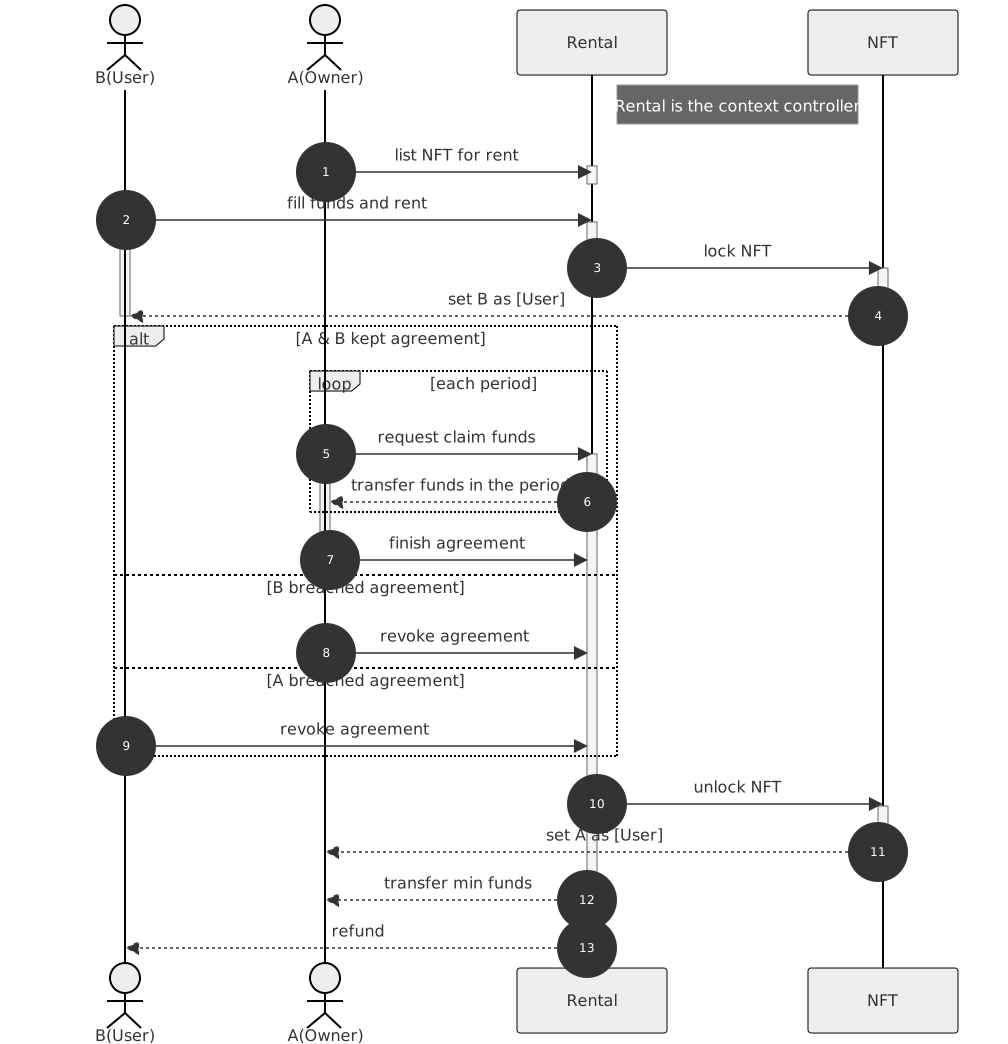
Rental
This is a typical use case for rentals, supposing A(owner) owns a token and wants to list his/her token for rent, and B(user) wants to rent the token to play in a certain game.
Mortgage
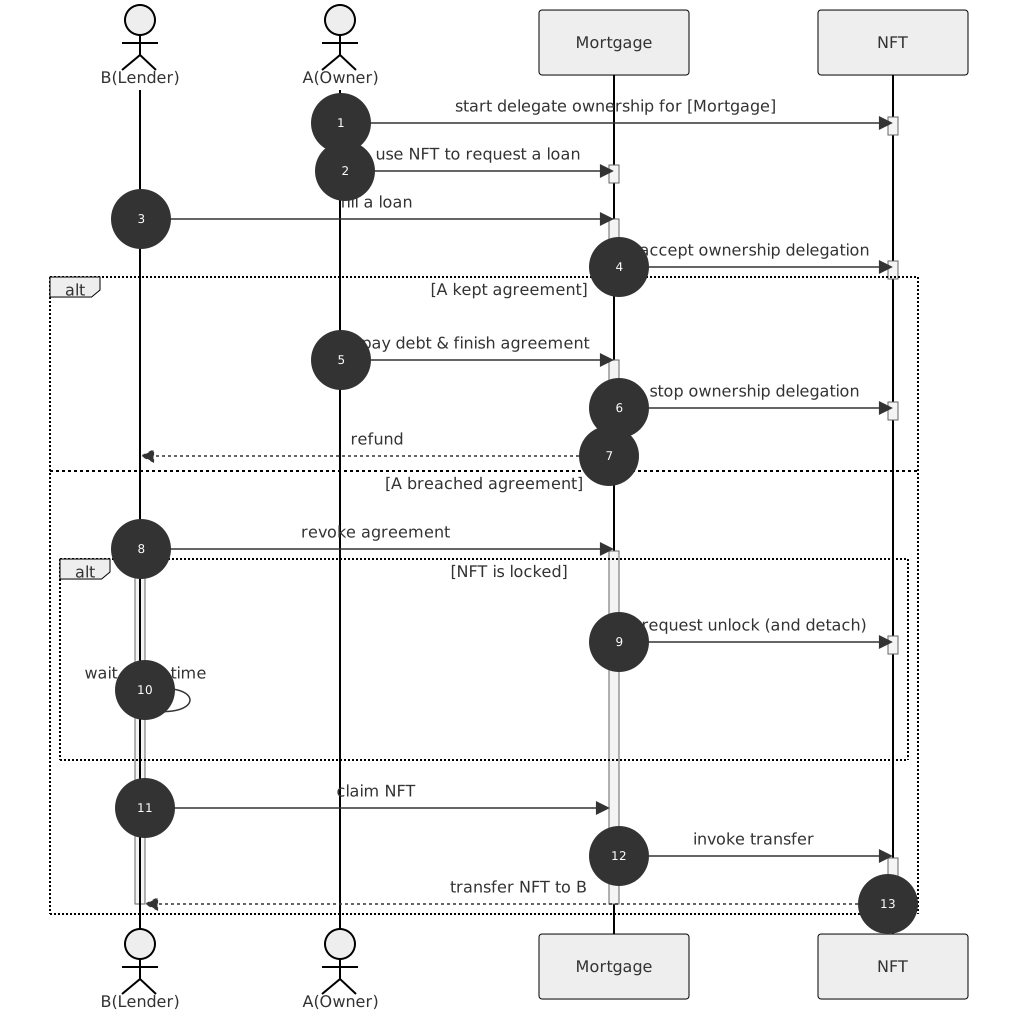
When constructing collateral systems, it is recommended to support token owners who wish to rent out their tokens while using them for collateral lending. This approach enhances the appeal of mortgage systems, creating a more attractive and versatile financial ecosystem that meets many different needs.
This is a typical use case for mortgages, supposing A(owner) owns a token and wants to mortgage, and B(lender) wants to earn interest by lending their funds to A.
Risk of Token Owner
Phishing attacks
It is crucial to note that the owner role has the ability to delegate ownership to another account, allowing it to authorize transfers out of the respective wallet. Consequently, some malicious actors could deceive the token owner into delegating them as a delegatee by invoking the startDelegateOwnership method. This risk can be considered the same as the approve or setApprovalForAll methods.
Ownership rights loss
When interacting with a contract system (e.g. mortgage), where owners have to delegate their ownership rights to the smart contract, it's imperative to:
- Ensure the timeframe for delegation is reasonable and not excessively distant. If the contract mandates a delegation period that extends too far into the future, make sure it includes a provision to revoke ownership delegation when specific conditions are met. Failing to include such a provision could lead to the loss of ownership rights until the delegation expires.
- Be aware that if the contract owner or their operator is compromised, the token ownership can be altered.
Copyright
Copyright and related rights waived via CC0.