ERC-7093: Social Recovery Interface
Interfaces for social recovery account supporting various guardian types and customizable recovery policies.
Metadata
Status: DraftStandards Track: ERCCreated: 2023-05-29
Authors
Requires
Abstract
This ERC proposes a standard interface for social recovery of smart contract accounts. It separates identity and policy verification from the recovery process, allowing more ways to authenticate (known as Guardians) than just on-chain accounts. It also lets users customize recovery policies without changing the account’s smart contract.
Motivation
Vitalik Buterin has long advocated for social recovery as an essential tool for user protection within the crypto space. He posits that the value of this system rests in its ability to offer users, especially those less acquainted with the technicalities of cryptography, a robust safety net when access credentials are lost. By entrusting account recovery to a network of selected individuals or entities, dubbed "Guardians," users gain a safeguard against the risk of losing access to their digital assets.
In essence, social recovery operates by verifying the identity of the user and the chosen Guardians, and then considering a set of their signatures. Should the validated signatures reach a specified threshold, account access is reestablished. This system is equipped to enforce complex policies, such as necessitating signatures from particular Guardians or reaching signature thresholds from different Guardian categories.
To overcome these limitations, this Ethereum Improvement Proposal (EIP) introduces a novel, customizable social recovery interface standard. This standard decouples identity and recovery policy verification from the recovery procedure itself, thereby enabling an independent, versatile definition and extension of both. This strategy accommodates a wider range of Guardian types and recovery policies, thereby offering users the following benefits:
- Appoint friends or family members, who do not have blockchain accounts, as Guardians for social recovery.
- Use NFTs/SBTs as Guardians for their accounts.
- Personalize and implement adaptable recovery policies.
- Support novel types of Guardians and recovery policies without needing to upgrade their account contracts.
- Enable multiple recovery mechanism support, thereby eliminating single points of failure.
This approach enables users to customize recovery policies without the need to change the smart contract of the account itself.
Specification
The key words "MUST", "MUST NOT", "REQUIRED", "SHALL", "SHALL NOT", "SHOULD", "SHOULD NOT", "RECOMMENDED", "NOT RECOMMENDED", "MAY", and "OPTIONAL" in this document are to be interpreted as described in RFC 2119 and RFC 8174.
This EIP consists of four key concepts:
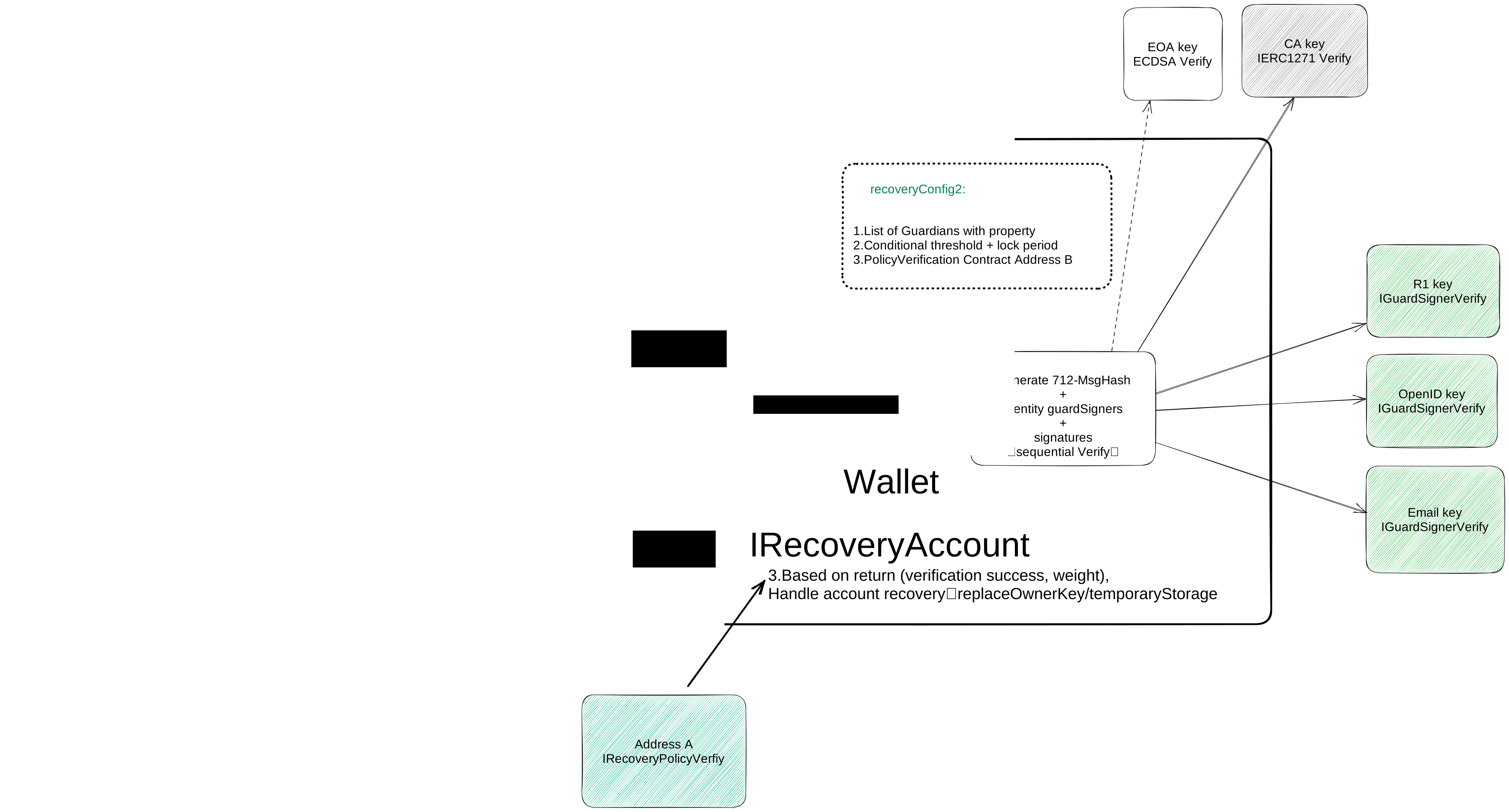
- Identity: This denotes the representation of a Guardian's identity on the blockchain. It encapsulates traditional on-chain account types such as Externally Owned Accounts (EOA) and Smart Contract Accounts (SCA). More importantly, it extends to include any identity construct capable of producing construct able to be verified on-chain, like signatures and proofs. This could range from Webauthn/Passkey R1 keys to Email DomainKeys Identified Mail (DKIM) signatures RFC 6376, OpenID tokens, Zero-Knowledge Proofs (ZKP), Non-Fungible Tokens (NFTs), SoulBound Tokens (SBTs), and even types yet to be developed. This comprehensive approach ensures a broad, forward-compatible support for various identity types.
- PermissionVerifier: This component defines how to verify the signature or proof provided by the Guardian. Regardless of whether the Guardian's account is on-chain or off-chain, the PermissionVerifier is invoked during the recovery process of smart contract accounts that incorporate a social recovery system. Its primary role is to confirm the validity of the Guardian's signature or proof, thereby ensuring the authenticity of the Guardian during the recovery process.
- RecoveryPolicyVerifier: This component offers a flexible interface for validating recovery policies. The flexibility stems from allowing account holders or authorized parties to define and store their recovery policies. During the recovery process, the verification logic is implemented by invoking the specific function of the contract instance adopting this interface. Thus, a wide array of customizable social recovery scenarios can be catered to through different contract instances and policy configurations. This contract is optional, because sometimes the contract designer may not need the policy abstraction.
- RecoveryAccount: This component encapsulates the core of the social recovery functionality. It is designed to be flexible, composable, and extensible to adapt to various recovery needs. Each RecoveryAccount is defined by an instance contract, crafted by smart contract developers, which embeds the essential logic for the recovery process.
- RecoveryModule: In some contract designs, many functions are not directly added to the account contract, but are implemented in the form of Module, which is a contract outside the account contract. This component encapsulates the core of the social recovery functionality. It is designed to be flexible, composable, and extensible to adapt to various recovery needs.
DataTypes
TypesAndDecoders
This defines the necessary data types required by this interface standard.
The Identity structure represents various types of guardians. The process of identity verification is as follows:
- When the
signervalue in the declared entity is empty, this implies that theIdentityentity is of EOA/SCA account type. In this case,guardianVerifieraddress should be the address of EOA/SCA (the actual signer). For permission verification of thisIdentityentity, it is recommended to utilize a secure library or built-in function capable of validating both ECDSA and ERC-1271 signatures. This helps in preventing potential security vulnerabilities, such as signature malleability attacks. - When the
signervalue in the declared entity is non-empty, this suggests that theIdentityentity is of non-account type. In this case, permission verification can be accomplished by callingguardianVerifieraddress contract instance throughIPermissionVerifierinterface.
Interfaces
IPermissionVerifier
The Guardian Permission Verification Interface. Implementations MUST conform to this interface to enable identity verification of non-account type guardians.
IRecoveryPolicyVerifier
The Recovery Policy Verification Interface. Implementations MAY conform to this interface to support verification of varying recovery policies. RecoveryPolicyVerifier is optional for SocialRecoveryInterface.
The verifyRecoveryPolicy() function is designed to validate whether the provided list of Permissions abides by the specified recovery properties (properties). This function has the following constraints and effects: For each matched guardian, calculations are made according to the corresponding property in the properties list (e.g., accumulating weight, distinguishing role while accumulating, etc.).
These constraints ensure that the provided guardians and properties comply with the requirements of the recovery policy, maintaining the security and integrity of the recovery process.
IRecoveryAccount
The Smart Contract Account MAY implement the IRecoveryAccount interface to support social recovery functionality, enabling users to customize configurations of different types of Guardians and recovery policies. In the contract design based on Module, the implementation of RecoveryModule is very similar to RecoveryAccount, except that different accounts need to be distinguished and isolated.
- For the
Guardian's signable message, it SHOULD employ EIP-712 type signature to ensure the content of the signature is readable and can be confirmed accurately during the Guardian signing process. getRecoveryNonce()SHOULD be separated from nonces associated with account asset operations, as social recovery is a function at the account layer.
Recovery Account Workflow
Note: This workflow is presented as an illustrative example to clarify the coordinated usage of the associated interface components. It does not imply a mandatory adherence to this exact process.
-
A user sets up a
recoveryPolicyConfigAwithin hisRecoveryAccount: -
When GuardianA and GuardianB assist the user in performing account recovery, they are to confirm the EIP-712 structured data for signing, which might look like this:
In this step, the guardians need to confirm that the domain separator's
verifyingContractis the correctRecoveryAccountaddress for the user, the contract name, version, and chainId are correct, and thepolicyVerifierandnewOwnersfields in themessagepart match the user's provided data.The
msgHashis then composed of:msgHash=keccak256("\\x19\\x01" + domainSeparatorV4() + dataHash)
Where,
dataHash=keccak256(EXECUTE_RECOVERY_TYPEHASH + configIndex + keccak256(bytes(newOwners)) + getRecoveryNonce())EXECUTE_RECOVERY_TYPEHASH=keccak256("StartRecovery(address configIndex, bytes newOwners, uint256 nonce)")
The guardians sign this hash to obtain the signature:
signature=sign(msgHash)
The
permissionis then constructed as:permission=guardian + signature
Once each Guardian has generated their unique
permission, all these individual permissions are collected to formpermissions:permissions= [guardianA+signature,guardianB+signature, ...]The
permissionsis an array that consists of all the permissions of the Guardians who are participating in the recovery process. -
A bundler or another relayer service calls the
RecoveryAccount.startRecovery(0xA, newOwners, permissions)function. -
startRecovery()function's processing logic is as follows:- Generate a message hash (
msgHash) from the input parameters0xA,newOwnersand internally generated EIP-712 signature parameters andRecoveryNonce. - Extract
guardianand correspondingsignaturefrom the input parameterspermissionsand process them as follows:- If
guardianA.signeris non-empty (Identity A), callIPermissionVerifier(guardianVerifier1).isValidPermissions(signerA, msgHash, permissionA.signature)to validate the signature. - If
guardianA.signeris empty (Identity B), call the internal functionSignatureChecker.isValidSignatureNow(guardianVerifier2, msgHash, permissionB.signature)to validate the signature.
- If
- Generate a message hash (
-
After successful verification of all
guardianssignatures, fetch the associatedconfigdata for policyVerifier address0xAand callIRecoveryPolicyVerifier(0xA).verifyRecoveryPolicy(permissions, properties). The functionverifyRecoveryPolicy()performs the following checks:Note that the
guardiansparameter in the function refers to the guardians whose signatures have been successfully verified.- Verify that
guardians(Identity A and B) are present inconfig.guardianInfoslist and are unique. - Accumulate the
propertyvalues ofguardians(30 + 30 = 60). - Compare the calculated result (60) with the
config.thresholdConfigs.threshold,the result is more than the first element (threshold: 50, lockPeriod: 24 hours) but less than the second element (threshold: 100, lockPeriod: ""), the validation is successful, and the lock period of 24 hours is returned.
- Verify that
-
The
RecoveryAccountsaves a temporary state{newOwners, block.timestamp + 24 hours}and incrementsRecoveryNonce. ARecoveryStartedevent is emitted. -
After the expiry time, anyone (usually a relayer) can call
RecoveryAccount.executeRecovery()to replacenewOwners, remove the temporary state, complete the recovery, and emit aRecoveryExecuteedevent.
Rationale
A primary design rationale for this proposal is to extend a greater diversity of Guardian types and more flexible, customizable recovery policies for a RecoveryAccount. This is achieved by separating the verification logic from the social recovery process, ensuring that the basic logic of the account contract remains unaltered.
The necessity of incorporating Verifiers from external contracts arises from the importance of maintaining the inherent recovery logic of the RecoveryAccount. The Verifiers's logic is designed to be simple and clear, and its fixed invocation format means that any security risks posed by integrating external contracts can be effectively managed.
The recoveryConfigs are critical to the RecoveryAccount and should be securely and effectively stored. The access and modification permissions associated with these configurations must be carefully managed and isolated to maintain security. The storage and quantity of recoveryConfigs are not limited to ensure the maximum flexibility of the RecoveryAccount's implementation.
The introduction of recoveryNonce into the RecoveryAccount serves to prevent potential replay attacks arising from the malicious use of Guardian's permissions. The recoveryNonce ensures each recovery process is unique, reducing the likelihood of past successful recovery attempts being maliciously reused.
Backwards Compatibility
No backward compatibility issues are introduced by this standard.
Reference Implementation
TBD.
Security Considerations
Needs discussion.
Copyright
Copyright and related rights waived via CC0.